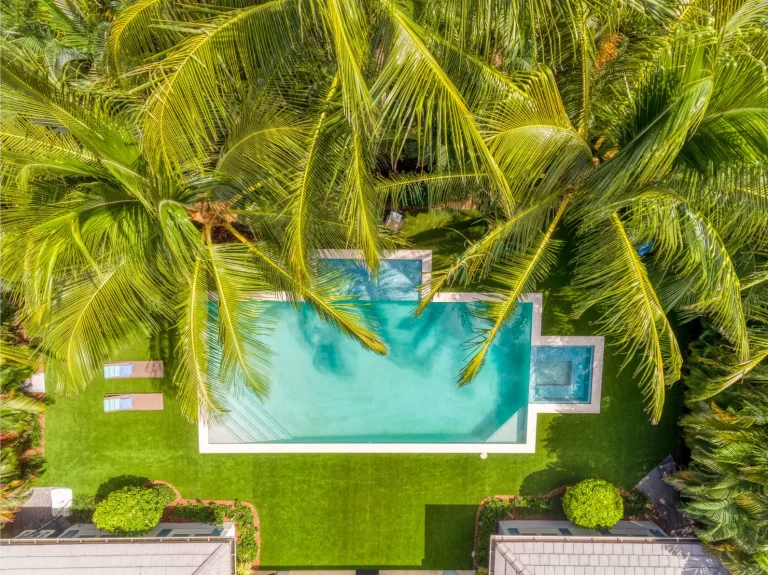
In West Palm Beach, pets live large—and so does outdoor time. That’s great for happiness and exercise, but tough on synthetic lawns. Dog lanes compact fibers. Urine crystallizes in the thatch. Afternoon storms add humidity that supercharges odors. The good news: with the right cleaning cadence, true enzyme chemistry (not perfume sprays), and a few repair-first techniques, a pet lawn can stay springy, odor-free, and photo-ready without constant replacements. This guide lays out a practical playbook tailored to local weather, salt air, and the way high-traffic yards actually get used—by people, paws, and the occasional cannonball into the pool.
If you’re new here, one idea runs through everything below: prevent buildup before it hardens. Turf is a system: blades + thatch over a perforated backing on a free-draining base. When fibers stay upright, infill sits at spec, and residues don’t clog the drainage path, the surface recovers quickly from daily pet use and summer storms alike. We’ll show you how to make that happen with small, repeatable habits.
Why Pet Turf in West Palm Beach Needs Its Own Plan
Humidity & afternoon showers. Moist, warm air helps bacteria flourish; residues that wouldn’t smell in a dry climate can turn pungent here, especially two days after a big rain when everything dries at once.
Salt and minerals. Coastal breeze and irrigation minerals leave deposits that dull fibers and trap odor molecules in the thatch.
Year-round sun. UV flattens unbrushed blades, and flat blades trap residues. Heat cycles also tug at seams and edges if they aren’t maintained.
High traffic. Multi-pet households and canine play create compacted lanes; paws grind infill out of spec if you don’t top up periodically.
Put simply: your turf isn’t failing—it’s just working hard. A pet-centric routine keeps it winning.
The Weekly–Monthly Baseline for Paw-Heavy Lawns
Every 2–3 days (5–10 minutes)
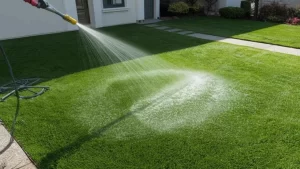
Targeted hose rinse of pet zones. Think “dilute and move along,” not “blast and bury.” Keep the nozzle above the thatch; you’re floating residues toward drains.
Quick debris pass. Palm seeds, leaves, and grass clippings trap moisture and feed odor.
Weekly (15–20 minutes)
Stiff-broom or light power-broom. Brush against the grain, then cross-brush, to stand fibers upright. Upright fibers shed residues better and look greener.
Spot enzyme treatment where dogs prefer to go; leave for the full dwell time before rinsing (more on enzymes below).
Monthly (30–45 minutes)
Deeper groom (power broom if you have one) to de-mat traffic lanes.
Infill check & top-up if you can part fibers and see backing easily. Adequate infill supports blades, shades the backing, reduces heat, and improves drainage.
Stain patrol. Treat irrigation rust or leaf tannins early; they bake in under summer sun.
For a locally tuned deep-clean cadence and route options, bookmark West Palm Beach turf cleaning as your city-specific reference.
Enzyme Odor Control That Actually Works
Why smells persist: Pet urine dries into uric salts/crystals that normal rinsing can’t fully dissolve. Scented deodorizers mask odor briefly but don’t change the chemistry.
What to use:
Multi-enzyme formulas (look for uricase and protease blends) to break the uric matrix and protein residues.
Oxidizers formulated for synthetic turf to disrupt biofilm and stubborn organics.
How to use (important):
Pre-rinse lightly so the surface is damp (enzymes work better with moisture).
Saturate the zone—not a mist. You want coverage through blades and thatch.
Honor dwell time. Don’t rinse early; enzymes need minutes to do chemistry.
Final rinse to move broken-down residues toward the drains.
Alternate monthly with an oxidizer during peak humidity to keep biofilm from re-forming.
If odor returns quickly: You’re likely dealing with deeper residue or compacted thatch—time for extraction and a thorough groom. For a bigger-picture reset (especially if you manage homes across the county), the route overview on South Florida turf cleaning explains multi-city scheduling and seasonal timing.
“Safe Cleaning” Means More Than Pet-Friendly Labels
Avoid over-pressure. High-PSI washers blow out infill, scuff fibers, and can open seams that softened in heat or during rains. Stick to a hose, extraction for silt, and grooming.
Be label-literal. Use turf-safe, EPA-registered disinfectants at the specified dilution. Some require a rinse; others don’t. Respect dwell times; disinfection without contact time is wishful thinking.
Mind overspray. Keep chemicals off natural beds where possible; rinse hardscape afterward if the label calls for it.
Choose the right infill. Blends with odor-binding media (like zeolite) shine in pet lanes, especially in humid months.
Grooming & Infill: The Look-New Triad
Lift fibers (brush or power broom): shows true color, reduces matting, and opens the thatch so rinses and enzymes reach residues.
Redistribute infill: fills low pockets where paws have removed granules; helps blades stand upright and reduces hot spots.
Top-up as needed: most residential systems sit around ~1.5–2.5 lb/sq ft (check your product spec). If you can see or feel backing, you’re under-filled.
Grooming is also when hidden issues reveal themselves: shallow ripples, early seam lift, or edging that wants attention.
Quick Repairs for High-Traffic Yards (Without Replacement)
Seam re-bond. If a straight seam opens (that “zipper” look), clean the channel, slide non-woven seam tape underneath, butter both edges with 2-part urethane adhesive (leave a slim glue-free margin near the blade tips), align gauge rows, weight evenly, and let it cure. Invisible results come from perfect alignment plus post-cure grooming.
Re-stretch + re-anchor. Ripples aren’t just cosmetic; they catch toys, toenails, and sandals. Lift near the ripple, correct any base high/low, re-tension the field, and add anchors at 6–8″ intervals in stress zones.
Edge reset at hardscape. If a putty knife slides under the edge near pavers or coping, clean the bond line and re-set with urethane adhesive or a mechanical edge strip. Weight during cure to keep the reveal crisp.
Small burn or dig patch. Beveled, oval cuts hide best. Trace a donor piece that matches grain/gauge, set on seam tape with adhesive, weight through cure, then power broom to blend.
Base touch-ups. For soft or puddling spots, roll back the turf, remove silted fines, rebuild with angular stone + DG in thin, compacted lifts, maintain cross-slope to drains, then re-stretch.
If you’re mapping options and costs beyond city limits, a concise breakdown of common methods (patching, re-stretching, seam/edge reconstruction, base correction) lives on South Florida turf repair for easy comparison.
The West Palm Beach Calendar for Pet Turf
January–March (drier air): Do a full grooming reset, top-up infill, and repair minor seams. Great window for elective fixes and stain removal (rust/tannin) before summer bakes them in.
April–June (wet ramp-up): Increase enzyme frequency to bi-weekly in dog lanes, check drains, and audit edges ahead of storms. Avoid high-PSI cleaning as heat climbs.
July–September (peak humidity + storms): After each major soaker: debris → gentle rinse → extraction if silt → disinfect (dwell!) → groom. Alternate enzyme and oxidizer passes two weeks apart.
October–December (reset and prep): Second comprehensive clean, re-stretch any ripples revealed by summer heat, detail edges for holiday foot traffic, document care for warranty files.
Readers who split time up the coast can find micro-climate notes for neighboring towns in their own guides—Boca Raton for south-county humidity patterns, Jupiter for coastal breeze and sport turfs, and Palm Beach Gardens for HOA commons and shaded cul-de-sacs.
Shared Spaces, HOAs & Dog Parks
Standardize the sequence. Staff and volunteers should follow the same order: debris → rinse → extraction (if silt) → disinfect → groom → inspect.
Signage helps. A small sign on gate rules (no glass, pick up solids, quick hose after use) lowers odor and extends intervals between deep cleans.
Route cleaning. In busy seasons, aligning professional deep cleans with trash days and landscaping routes minimizes scheduling friction and keeps the surface at its best rhythmically.
For a city-level schedule reference tied to local weather patterns and route timing, keep turf cleaning in West Palm Beach handy as your go-to calendar.
Drainage & Hygiene: Two Simple Tests
Hose test: In a corner, spray a gentle flow; water should disappear through the thatch in seconds. If it puddles, you likely have silt in the thatch/backing or a base depression.
White-towel swipe: After a dry day, rub a clean towel across a traffic lane. Brown/gray film means biofilm or dust that needs a proper groom and possibly a disinfectant pass.
When stubborn residues linger across multiple properties, it can save time to coordinate an area-wide reset; a quick overview of multi-city options appears on South Florida turf cleaning for planning.
Turf Installation Services in West Palm Beach
If your lawn is reaching the end of its product life—or you’re designing a pet-centric yard from the ground up—installation quality determines how often you’ll need repairs later. Proper base compaction, smart drainage, seam layout, and edge detailing are the foundation of low-odor, low-maintenance performance. For a local primer on product choices and layouts, explore Blue Ocean Turf’s West Palm Beach artificial grass; pair a solid install with the pet-friendly care cadence above to keep maintenance light for years.
Frequently Asked Questions
How often should a West Palm Beach pet lawn be deep-cleaned?
Most pet households thrive on a quarterly deep clean—grooming, enzyme/oxidizer cycle, and an infill check—with bi-weekly enzyme passes during peak humidity. Multi-dog yards or shaded courtyards might add an extra mid-summer service.
Are bleach or vinegar good disinfectants for turf?
We don’t recommend them. Bleach and high-acid solutions can discolor fibers, degrade backing, and harm nearby plants. Choose turf-safe, EPA-registered products and follow the label precisely.
My turf smells worse after rain—what gives?
Stormwater mobilizes residues into the thatch. As the surface warms and dries, odors concentrate. Alternate enzyme and oxidizer treatments, honor dwell times, and extract silt instead of pushing it deeper.
Can I safely use a pressure washer on pet turf?
Not at high PSI. Over-pressure ejects infill, roughens fibers, and can lift seams. A garden hose, extraction for fines, and a power broom provide safer, better results.
What’s the best infill for dogs?
Many owners like coated sands blended with odor-binding media (e.g., zeolite) for pet lanes. Whatever you choose, maintaining depth to spec matters more than the brand name.
How do I fix a small dig spot from my dog?
For shallow scrapes, a groom + infill top-up often restores the surface. For torn backing, cut a beveled oval, patch with matching grain on seam tape and urethane adhesive, weight to cure, then power broom.
Why do seams open near heat or after storms?
Heat cycles and moisture stress aging adhesives. Timely re-bonds—clean channel, non-woven tape, urethane adhesive, perfect alignment, proper cure—restore integrity and appearance.
How much brushing is too much?
Weekly light brushing is ideal; over-grooming with aggressive tools can scuff fibers. If you use a power broom, short, even passes are safer than repeated heavy pressure in one lane.
Do disinfectants hurt pets or landscaping?
Used at labeled dilutions, turf-safe disinfectants are designed for outdoor surfaces. Control overspray and rinse nearby hardscape if the label calls for it.
When do I choose repair vs. replacement?
Repair wins when damage is localized and backing/drainage are sound—seam re-bonds, patches, edge resets, and re-stretching solve most issues. Replace when fibers are UV-brittle site-wide or the base is failing extensively.
Book Same-Week Pet Turf Care in West Palm Beach
Lock in a rhythm that keeps your yard fresh, safe, and guest-ready: a seasonal deep clean, bi-weekly enzyme cadence in dog lanes, and quick micro-repairs before small issues spread. Bundle grooming, infill top-ups, disinfectant passes, seam re-bonds, and edge resets in one efficient visit, then use the weekly rinse + monthly brush habits to keep that new-lawn look going—through humidity, playdates, and every pool party in between.